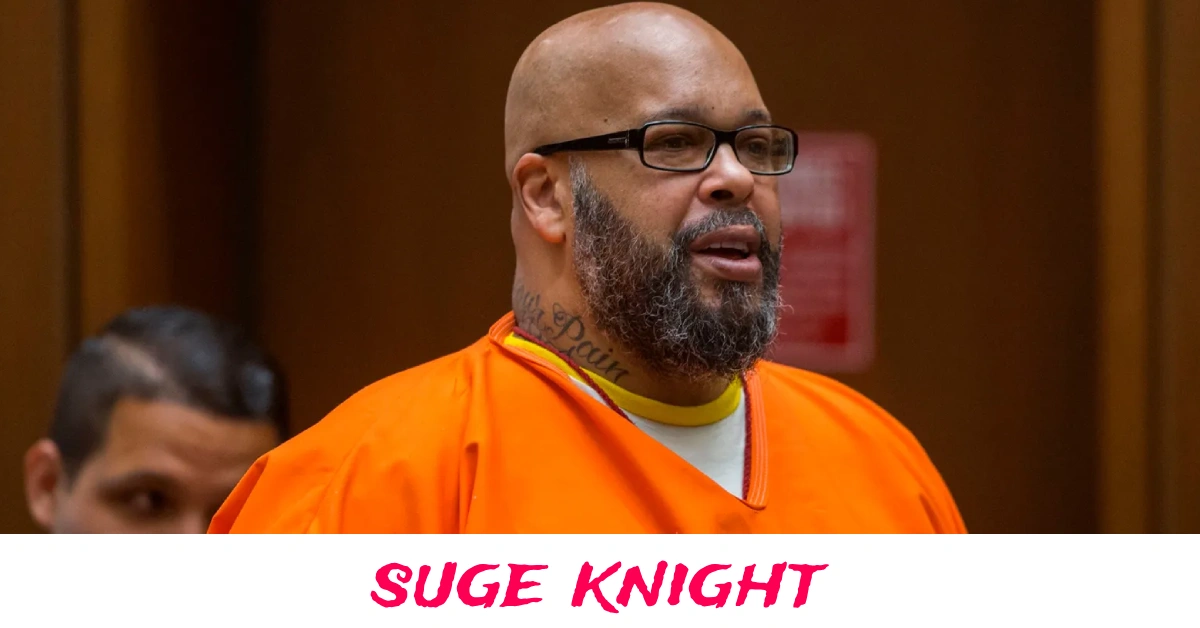
Marion “Suge” Knight Jr. is the co-founder of Death Row Records who worked with Dr. Dre, Snoop Dogg and Tupac Shakur. He is currently serving a 28-year sentence in prison for a fatal hit-and-run in 2015.
Marion Hugh “Suge” Knight Jr. stands as one of hip-hop’s most controversial figures. The co-founder of Death Row Records worked with industry legends like Dr. Dre, Snoop Dogg and Tupac Shakur, helping shape the sound of 1990s West Coast rap. Yet his story is equally defined by violence, legal troubles, and a dramatic fall from grace that landed him in prison for nearly three decades.
Today, Knight represents both the heights of music industry success and the consequences of a life marked by criminal behavior. His journey from NFL aspirations to record label empire to federal prison cell offers a cautionary tale about power, violence, and the price of criminal choices.
Early Life and Football Career
Knight was born on April 19, 1965, in Compton, California, to parents Maxine and Marion Knight Sr. His nickname “Suge” derives from “Sugar Bear,” a childhood moniker that would later become synonymous with both music industry success and criminal intimidation.
Growing up in Compton during the 1970s and 1980s, Knight witnessed firsthand the gang violence and street culture that would later influence the artists he represented. He attended Lynwood High School in nearby Lynwood, where he excelled as a football and track star, graduating in 1983.
Knight’s athletic ability earned him college opportunities. From 1983 to 1985, he attended and played football at El Camino College before transferring to the University of Nevada, Las Vegas, where he played football for two years.
Despite his college success, Knight went undrafted in the 1987 NFL draft but was invited to the Los Angeles Rams training camp. He was cut during camp but became a replacement player during the 1987 NFL Players Strike, playing two games for the Rams.
This brief NFL experience would be Knight’s only taste of legitimate professional sports success. When his football dreams ended, he turned to the entertainment industry, setting the stage for both his greatest triumphs and ultimate downfall.
Building the Death Row Empire
After his football career ended, Knight worked as a bodyguard and concert promoter for celebrities including Bobby Brown. His first major business success came through aggressive tactics that would become his trademark. Knight’s first big profit came when Vanilla Ice agreed to sign over royalties from “Ice Ice Baby” because the song included material allegedly written by Knight’s client Mario Johnson.
The Vanilla Ice incident, involving rumors of physical intimidation, established Knight’s reputation for using fear as a business tool. This approach would prove both highly effective and ultimately destructive.
Knight next formed an artist management company, signing West Coast hip hop artists DJ Quik and The D.O.C. Through The D.O.C., he met members of the influential gangsta rap group N.W.A, including Dr. Dre, who wanted to leave their label Ruthless Records.
According to N.W.A’s manager Jerry Heller, Knight and his associates threatened Heller and Eazy-E with lead pipes and baseball bats to make them release Dre, The D.O.C., and Michel’le from their contracts in April 1991.
This aggressive negotiation led to Death Row Records’ formation in 1991. Death Row Records was founded by The D.O.C., Dr. Dre, Suge Knight, Dick Griffey, and Harry-O. The label became a sensation by releasing multi-platinum hip-hop albums by West Coast-based artists.
Knight’s vision was ambitious: he vowed to make Death Row “the Motown of the ’90s.” For a brief period, this dream seemed achievable.
The Golden Years: Success and Controversy
Death Row Records achieved unprecedented success in the early 1990s. Knight secured a distribution deal with Interscope, and Dre’s 1992 solo debut album, The Chronic, earned triple platinum status in the United States by the end of 1993.
The success continued with Snoop Dogg’s debut album Doggystyle, which obtained quadruple platinum certification in the United States in 1994. At its peak, Death Row made over $100 million annually.
Knight’s most significant artist signing came in 1995 when he posted $1.4 million bail for Tupac Shakur, who was serving time for sexual abuse charges. Knight struck a deal with Shakur that October, posting his bail and freeing him from prison pending an appeal of his conviction, while signing him to Death Row Records.
This partnership produced Tupac’s most commercially successful work. In 1996, the label released Shakur’s All Eyez on Me, which became his greatest commercial success.
However, Knight’s business practices increasingly involved violence and intimidation. Knight is affiliated with the Mob Piru Bloods, a set of the Bloods gang, and hired members from this gang to work for Death Row Records.
The label’s success was accompanied by a public feud with East Coast entrepreneur Sean Combs. Knight’s infamous appearance at the 1995 Source Awards, where he openly criticized Combs, helped fuel the East Coast-West Coast rap rivalry that would have tragic consequences.
The Tupac Tragedy and Beginning of the End
The night of September 7, 1996, changed everything for Knight and Death Row Records. After departing a Mike Tyson boxing match in Las Vegas, a group that included Knight and Shakur assaulted Orlando Anderson, a Southside Compton Crips gang member. Three hours later, someone shot into the car Knight was driving, injuring Knight and fatally wounding Shakur.
Tupac Shakur died six days later on September 13, 1996. The murder remains officially unsolved, though numerous theories have emerged about Knight’s potential involvement.
The tragedy marked the beginning of Death Row’s decline. Dr. Dre left Death Row Records shortly before Shakur’s death, followed by Snoop Dogg two years later. The label rapidly declined.
Meanwhile, allegations mounted that Knight, beyond employing gang members, often used intimidation and violence in his business dealings.
Legal Troubles and Financial Collapse
Knight’s legal problems began accumulating in the late 1990s. From the late 1990s to the early 2000s, Knight spent a few years incarcerated for assault convictions and associated violations of probation and parole.
In a 1995 federal case, Knight pleaded no contest and was sentenced to five years’ probation for assaulting two rappers in the summer of 1992 at a Hollywood recording studio.
His most significant early sentence came in 1997. Knight was sentenced to nine years in prison on February 28, 1997, for the probation violation but was granted early release and was let out of FCI Sheridan on August 6, 2001.
Financial troubles accompanied his legal issues. On April 4, 2006, Knight filed bankruptcy due to civil litigation against him in which Lydia Harris was said to have been cheated out of a 50% stake in Death Row Records.
The bankruptcy documents revealed the extent of his financial collapse. According to financial records, his bank account contained just $11, and he owned clothing worth $1,000, furniture and appliances valued at $2,000, and jewelry worth $25,000.
In June 2008, Death Row Records was put up for auction in Bankruptcy Court. The winning bid went to New York-based company Global Music Group. Global Music Group failed to secure funding and the Death Row Records catalog eventually went to Wideawake Entertainment.
The Fatal Hit-and-Run and Prison Sentence
Knight’s most serious legal trouble began on January 29, 2015. Knight ran down two men with a pickup truck in Compton, killing one and injuring the other. The incident occurred when Knight crashed his car into two men, killing Terry Carter (his friend and co-founder of Heavyweight Records), and fled the scene in Compton, California.
Witnesses said Knight followed the men to a burger stand parking lot after an argument on the Straight Outta Compton film set, and that the collision looked intentional. Security footage video showed Knight running over both men. Knight said he acted in self-defense.
The legal proceedings were lengthy and complicated by Knight’s health issues. In March 2017, Knight was hospitalized after suffering from blood clots, a condition that had been affecting him for two and a half years by that time. Knight’s hospitalization delayed the trial to September 2018.
In September 2018, Knight pled no contest to voluntary manslaughter in a fatal 2015 hit-and-run incident. The co-founder of Death Row Records, who is 53, agreed to a plea deal for one count of voluntary manslaughter. He had been facing charges of murder and attempted murder.
The judge sentenced Knight to 28 years in prison: 22 years for running over the victim and 6 years because it was Knight’s third strike under California’s three-strikes law. He was sentenced to 28 years in prison, and is eligible for parole in October 2034, when he will be 69 years old.
Current Status and Net Worth
Today, Knight serves his sentence at RJ Donovan Correctional Facility in San Diego. Recent attempts to overturn his 28-year prison sentence have been unsuccessful, with judges calling his efforts “not sincere.”
Knight’s financial situation reflects his dramatic fall from grace. According to Celebrity Net Worth, Suge Knight’s current net worth is estimated at $200,000, a massive decline from his peak wealth. At the height of his career, Knight’s net worth was estimated to be around $100 million, amassed through record sales, partnerships, and a lavish lifestyle that included luxury cars and properties.
Knight has maintained some public presence through a podcast from prison called “Collect Call With Suge Knight,” though it’s unclear whether he earns money from this endeavor.
The Complex Legacy of Suge Knight
Marion “Suge” Knight’s story represents one of the most dramatic rises and falls in entertainment industry history. His contributions to hip-hop culture are undeniable – Death Row Records produced some of the most influential albums in rap history and helped establish West Coast hip-hop as a dominant cultural force.
Yet Knight’s legacy remains forever tainted by violence, intimidation, and criminal behavior. His story serves as a cautionary tale about the dangers of mixing legitimate business success with criminal activity.
The artists who worked with Knight – Dr. Dre, Snoop Dogg, Tupac Shakur – went on to achieve lasting success and cultural influence. Knight, meanwhile, spent much of his later life behind bars, watching from prison as the hip-hop industry he helped build continued to grow without him.
His current situation – serving a 28-year sentence with parole eligibility only in 2034 – effectively ends his active participation in the music industry. At 60 years old, Knight’s story has become a historical footnote, remembered more for its tragic elements than its musical achievements.
The Suge Knight saga ultimately illustrates how talent, business acumen, and cultural influence mean nothing without the wisdom to stay within legal boundaries. His fall from music mogul to convicted felon serves as a powerful reminder that success built on violence and intimidation is ultimately unsustainable.
FAQs
What is Suge Knight doing now?
Suge Knight is currently serving a 28-year prison sentence at RJ Donovan Correctional Facility in San Diego. He is eligible for parole in October 2034, when he will be 69 years old.
Why is Suge Knight in prison?
Suge Knight was sentenced to 28 years in prison for the death of a man during a hit-and-run incident on the set of the movie “Straight Outta Compton.” He pled no contest to voluntary manslaughter charges.
What was Suge Knight’s role in Death Row Records?
Suge Knight was the co-founder of Death Row Records, having worked with Dr. Dre, Snoop Dogg and Tupac Shakur. He served as CEO during the label’s most successful period in the 1990s.
What is Suge Knight’s current net worth?
Suge Knight’s current net worth is estimated at $200,000, a dramatic decline from his peak wealth of approximately $100 million during Death Row Records’ heyday.
When will Suge Knight be released from prison?
Suge Knight is eligible for parole in October 2034, when he will be 69 years old. Recent attempts to overturn his sentence have been unsuccessful.
What happened between Suge Knight and Tupac?
Knight posted $1.4 million bail for Tupac Shakur in 1995, signing him to Death Row Records. On September 7, 1996, Knight was driving the car when Tupac was fatally shot in Las Vegas after they attended a Mike Tyson boxing match.
Death Row Records Major Artists
| Artist | Albums Released | Platinum Status | Years with Label |
|---|---|---|---|
| Dr. Dre | The Chronic (1992) | Triple Platinum | 1991-1996 |
| Snoop Dogg | Doggystyle (1993) | Quadruple Platinum | 1991-1998 |
| Tupac Shakur | All Eyez on Me (1996) | Multi-Platinum | 1995-1996 |
| Tha Dogg Pound | Dogg Food (1995) | Double Platinum | 1992-1999 |


