


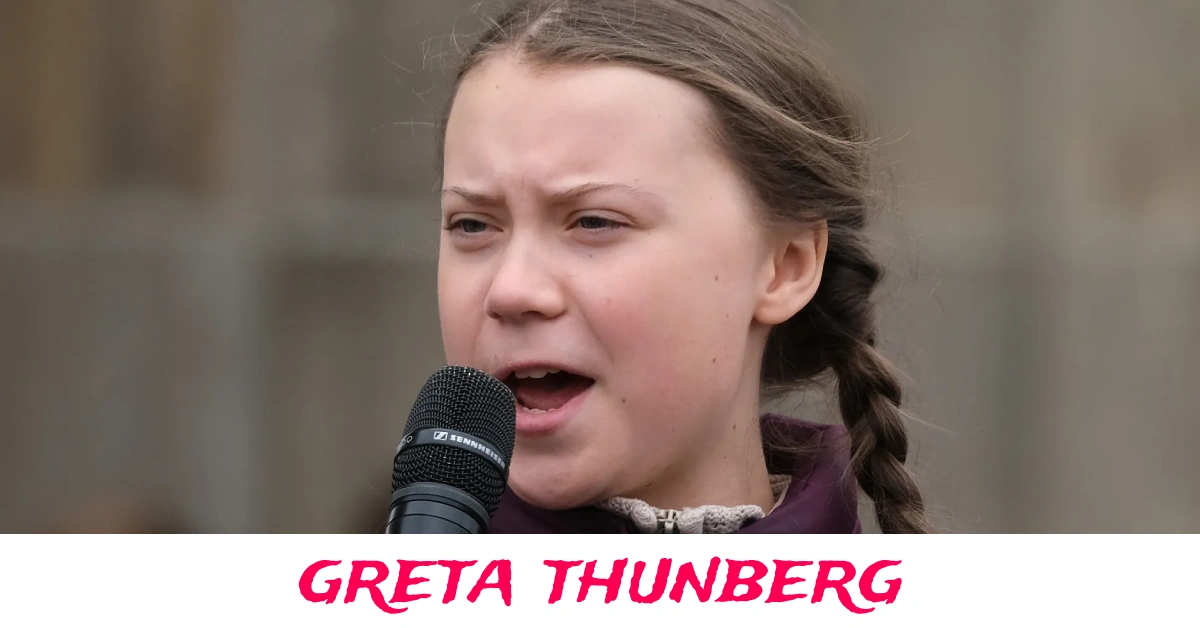
Greta Thunberg is a Swedish environmental activist born in 2003 who gained global recognition after starting school climate strikes in August 2018 at age 15. Her “Fridays for Future” movement has inspired millions worldwide to demand urgent climate action, making her the youngest Time Person of the Year in 2019.
Who Is Greta Thunberg? The Teen Who Started a Climate Revolution
Greta Tintin Eleonora Ernman Thunberg was born on 3 January 2003, in Stockholm, Sweden, to opera singer Malena Ernman and actor Svante Thunberg. What began as a solitary protest outside the Swedish parliament in August 2018 grew into a worldwide climate movement that reshaped environmental activism.
In August 2018, aged 15, Thunberg began skipping school, vowing to remain out of school until after a Swedish election to attempt to influence the outcome. Her homemade sign reading “Skolstrejk för Klimatet” (School Strike for Climate) became the symbol of a generation’s frustration with climate inaction.
The timing wasn’t accidental. Her protest began after the heat waves and wildfires during Sweden’s hottest summer in at least 262 years. This direct connection between climate science and immediate environmental impacts became central to her messaging approach.
Early Life and Personal Background
Family Influence and Education
Her paternal grandfather was actor and director Olof Thunberg. Growing up in an artistic family exposed her to public performance and communication skills that later proved invaluable in her activism.
Thunberg says she first heard about climate change in 2011, when she was eight years old, and could not understand why so little was being done about it. This early exposure to climate science shaped her worldview dramatically.
Mental Health Journey and Neurodiversity
Eventually, she was diagnosed with Asperger syndrome, obsessive–compulsive disorder (OCD), and selective mutism. Rather than viewing these as limitations, Thunberg reframed them as strengths.
While acknowledging that her diagnosis “has limited [her] before”, Thunberg does not view her Asperger’s as an illness, and has instead called it her “superpower”. This perspective helped destigmatize neurodiversity in activism.
The situation depressed her, and as a result, at the age of 11, she stopped talking and eating much and lost ten kilograms (22 lb) in two months. Her recovery through activism demonstrates how purpose can transform personal struggle into global impact.
The Birth of Fridays for Future
From Parkland to Parliament
In an interview with Amy Goodman of Democracy Now!, she said she got the idea of a climate strike after school shootings in the United States in February 2018 led several youths to refuse to return to school. The connection between American gun violence protests and climate activism shows how global youth movements influence each other.
In May 2018, Thunberg won a climate change essay competition held by Swedish newspaper Svenska Dagbladet. In part, she wrote: “I want to feel safe. How can I feel safe when I know we are in the greatest crisis in human history?”
The First Strike Day
On 20 August 2018, Thunberg, who had just started ninth grade, decided not to attend school until the 2018 Swedish general election on 9 September. Her demands were clear: Sweden must reduce carbon emissions according to the Paris Agreement.
After Thunberg posted a photo of her first strike day on Instagram and Twitter, other social media accounts quickly took up her cause. The power of social media amplification turned a local protest into global news within days.
Throughout the autumn of 2018, Thunberg’s activism evolved from a solitary protest to taking part in demonstrations throughout Europe, making several high-profile public speeches, and mobilizing her followers on social media platforms.
Global Impact and Recognition
The “Greta Effect” on Climate Discourse
Thunberg’s influence on the world stage has been described by The Guardian and other media as the “Greta effect”. This phenomenon encompasses her ability to shift public opinion, media coverage, and political discourse on climate change.
In December alone, more than 20,000 students held strikes in at least 270 cities. The rapid global spread of school climate strikes demonstrated unprecedented youth mobilization around environmental issues.
Major Awards and Honors
She has received honours and awards, including in Time’s 100 most influential people, named the youngest Time Person of the Year in 2019, inclusion in the Forbes list of The World’s 100 Most Powerful Women (2019), and nominations for the Nobel Peace Prize.
Her recognition extended beyond activism awards. She became a cultural icon representing youth agency and environmental urgency across multiple sectors.
Iconic Speeches and Moments
“How Dare You” – The UN Climate Action Summit
On 23 September 2019, Thunberg attended the UN Climate Action Summit in New York City. Her speech became one of the most memorable climate addresses in recent history.
“This is all wrong. I shouldn’t be up here. I should be back in school on the other side of the ocean. Yet you all come to us young people for hope. How dare you!” This emotional appeal resonated globally, making “How dare you” a rallying cry for climate action.
Carbon-Free Travel Commitment
In August 2019, Thunberg sailed across the Atlantic Ocean from Plymouth, England, to New York City, in the 60-foot (18 m) racing yacht Malizia II, equipped with solar panels and underwater turbines. This 15-day journey demonstrated her commitment to reducing personal carbon emissions.
While in New York, Thunberg was invited to give testimony in the US House Select Committee on the Climate Crisis on 18 September. Instead of testifying, she gave an eight-sentence statement and submitted the IPCC Special Report on Global Warming of 1.5 °C as evidence.
Climate Activism Philosophy and Methods
Scientific Foundation
According to political scientists Mattia Zulianello and Diego Ceccobelli, Thunberg’s ideas can be defined as technocratic ecocentrism, which is grounded on “the exaltation of the vox scientifica”. Her approach consistently prioritizes scientific evidence over political compromise.
In order to take the necessary action, she added that politicians should not listen to her, they should listen to what the scientists are saying about how to address the crisis. This deference to expertise while maintaining activist pressure represents a unique approach in environmental advocacy.
Urgency-Focused Messaging
She says that lowering emissions is not enough, that emissions need to be reduced to zero if the world is to keep global warming to less than 1.5 °C. Her absolutist stance on emissions targets reflects current climate science consensus.
More specifically, Thunberg has argued that commitments made at the Paris Agreement are insufficient to limit global warming to 1.5 degrees, and that the greenhouse gas emissions curve needs to start declining steeply no later than 2020.
Evolution of Activism (2020-2025)
COVID-19 Pandemic Response
On 24 August 2020, Thunberg ended her “gap year” from school when she returned to the classroom. The COVID-19 pandemic severely restricted travel and meetings in 2020 and 2021. She adapted by moving activities online and connecting pandemic response to climate action.
On 13 March 2020, Thunberg stated that “In a crisis we change our behavior and adapt to the new circumstances for the greater good of society.” Thunberg and School Strike for Climate subsequently moved their activities online.
Expanding Social Justice Focus
Thunberg’s activism has evolved to include other causes, supporting Ukraine, Palestine, Armenia and Western Sahara in their respective conflicts with Russia, Israel, Azerbaijan and Morocco. This broadening demonstrates how climate justice intersects with human rights issues.
Following the Israeli capture of yet another aid flotilla in July 2025, Thunberg joined the Global Sumud Flotilla, which is said to be the largest civilian effort to break the siege of Gaza and is setting sail between August and September 2025.
Recent Protests and Legal Challenges
After Thunberg graduated from high school in 2023, her activism continued to gain international attention and her protest tactics have become increasingly assertive. Her adult activism includes both peaceful demonstrations and civil disobedience.
As an adult, her protests have included both peaceful demonstrations and acts of civil disobedience such as defying lawful orders to disperse, which have led to arrests, convictions, and an acquittal.
Global Movement Impact
Fridays for Future Growth
The movement Thunberg started has become autonomous and worldwide. In 2019, coordinated multi-city protests involved over a million students each. These demonstrations represent the largest youth-led environmental protests in history.
The school strikes for climate on 20 and 27 September 2019 were attended by over four million people, according to one of the co-organisers. This scale of participation demonstrates unprecedented global youth engagement with climate issues.
Environmental Policy Influence
Democratic candidates for the 2020 United States presidential election such as Kamala Harris, Beto O’Rourke, and Bernie Sanders expressed support after her speech at the September 2019 action summit in New York.
German Chancellor Angela Merkel indicated that young activists such as Thunberg had driven her government to act faster on climate change. This direct policy influence shows how activism can accelerate governmental responses.
Economic and Cultural Impact
In August 2019, publication and sales of children’s books about the climate crisis reportedly doubled compared to the previous year. Publishers attribute this to the “Greta effect”.
Thunberg has spearheaded the anti-flying movement, promoting rail travel over flying on environmental grounds. The “flight shame” movement has measurable impacts on travel behavior.
Sweden reported a 4% drop in domestic air travel for 2019 and an increase in rail use.
Criticism and Controversies
Political Opposition
Thunberg and her campaign have been criticized by politicians as well, ranging from personal attacks to statements that she oversimplifies the complex issues involved. Critics include world leaders from multiple countries.
In September 2019, Trump shared a video of Thunberg angrily addressing world leaders, along with her quote that “people are dying, entire ecosystems are collapsing. We are in the beginning of a mass extinction.” Trump wrote about Thunberg, tweeting: “She seems like a very happy young girl looking forward to a bright and wonderful future. So nice to see!”
Media Response Strategy
Thunberg reacted by changing her Twitter bio to match his description, and stating that she could not “understand why grown-ups would choose to mock children and teenagers for just communicating and acting on the science when they could do something good instead.”
This response pattern—turning criticism into profile descriptions—became a signature way of defusing attacks while maintaining focus on climate science.
Current Status and Future Directions
Educational Path
On 9 June 2023, Thunberg graduated from high school and marked the day by attending what would be her last school strike for climate protest before receiving her diploma. Her transition from student activist to adult advocate marks a new phase.
Publications and Media
In late 2022, Thunberg’s The Climate Book was released. It is a compilation in which she brought together over one hundred experts—geophysicists, oceanographers and meteorologists; engineers, economists and mathematicians; historians, philosophers and indigenous leaders—who wrote essays focusing on changes to the Earth’s climate.
Continued Activism
Thunberg boycotted COP29, hosted in 2024 in Azerbaijan by the regime of autocratic leader Ilham Aliyev, due to human rights violations and ethnic cleansing of Armenians in the disputed Nagorno-Karabakh, and instead visited neighboring Georgia and Armenia.
FAQs
What started Greta Thunberg’s climate activism?
Thunberg began activism after learning about climate change at age 8 and feeling frustrated by global inaction during Sweden’s record-breaking hot summer of 2018.
How did Fridays for Future begin?
The movement started with Thunberg’s solo school strike outside Swedish Parliament in August 2018, which gained social media attention and inspired global student protests.
What is the “Greta Effect”?
The term describes Thunberg’s influence on raising climate awareness, changing travel behaviors, increasing environmental book sales, and accelerating political climate action worldwide.
Why does Thunberg avoid flying?
She refuses air travel due to aviation’s high carbon emissions, instead using trains, boats, and other low-carbon transportation methods to demonstrate climate commitment.
What awards has Greta Thunberg received?
Major recognitions include Time Person of the Year 2019, Forbes 100 Most Powerful Women, multiple Nobel Peace Prize nominations, and inclusion in Time’s 100 Most Influential People.
How has her activism evolved since 2018?
Thunberg’s focus has expanded from solely climate issues to encompass broader social justice causes, including conflicts in Ukraine, Palestine, and Armenia, while maintaining environmental advocacy.
Conclusion:
Greta Thunberg transformed from a concerned Swedish teenager into a global climate icon whose influence extends far beyond environmental activism. Her direct communication style, scientific focus, and personal commitment to carbon reduction have inspired millions while challenging world leaders to prioritize climate action. As she continues advocating as an adult, her early impact demonstrates how individual action can catalyze worldwide movements for systemic change. The “Greta effect” represents not just one person’s influence, but the power of youth voices demanding accountability for planetary stewardship.