Learning how to become a choreographer starts on stage, not in an office. You train as a dancer first, then learn to build routines for other dancers. Most choreographers spend years performing before they lead a rehearsal room. No single exam or licence grants the title.
This guide follows the route the industry itself describes. Our guide to how to become famous covers the public fame that can follow stage success. This guide covers the slower craft underneath: training, assistant work, small pieces and first paid jobs.
Key Takeaways
- Train as a dancer before you choreograph for others
- Assistant roles teach rehearsal craft faster than courses alone
- Small pieces and video clips prove your work to hirers
- Learning how to become a choreographer takes years on stage first
- Freelance fees vary by project, so teaching steadies income
- A showreel of finished work beats a list of course names
How to Become a Choreographer: What the Job Really Involves
A choreographer invents dance routines and teaches them to performers. You turn music, story or a brief into steps that a cast can repeat. You also choose formations, spacing and timing for each section. The work ends only when the cast can perform it without prompts.
Choreographers work in ballet, musical theatre, television, film, music videos and live events. Some lead a whole show, while others shape one number inside a larger production. You may also work as a movement director for actors. That role coaches period manners, fight shapes or comic movement.
Choreographers also shape pop tours and videos, where routines must read on camera. PEOPLE recently profiled Vincent Paterson, who choreographed for Michael Jackson and Madonna tours. His work shows how one routine can travel from a studio to stadiums worldwide.
- Develop ideas into dance routines
- Work with producers and musical directors on storylines
- Choose music, costume styles and props
- Hold auditions and instruct dancers
- Record steps with notation or video
- Lead rehearsals until show night
Train First: Dance Courses, Auditions and Entry Routes
No course alone makes a choreographer, but strong dance training opens every door. You can enter through a university course, through work towards the role, or by direct application. Each route still demands a high level of dance training and experience. Auditions decide most course places, not written forms alone.
Relevant subjects include dance, dance performance, musical theatre and dance and choreography. Entry often asks for 1 or 2 A levels for a foundation degree. A degree asks for 2 to 3 A levels instead. The National Careers Service choreographer profile lists these routes in full.
| Route | What it gives | Who it suits |
|---|---|---|
| University course | Structured training, technique and stage time | School leavers with strong dance training |
| Working towards the role | Paid stage time plus gradual choreography chances | Dancers already working in shows |
| Direct application | A straight pitch based on experience | Experienced dancers and dance teachers |
Start as a Dancer: The Usual Route Onto the Stage
Most choreographers start as professional dancers, not as choreographers. Stage time teaches timing, stamina, spacing and how casts behave under pressure. You learn what dancers need from a leader by working under good and bad ones. That lived knowledge shapes every routine you later build.
Our guide to how to become a dancer covers auditions, training and daily class in detail. Read it beside this guide if stage work still feels new. Dancers often combine performing with teaching between contracts, which keeps income steadier.
- Ballet and contemporary
- Jazz, tap and musical theatre
- Street and commercial
- Ballroom, folk and world styles
Learn Beside a Choreographer: Assistant Roles and Dance Captain Work
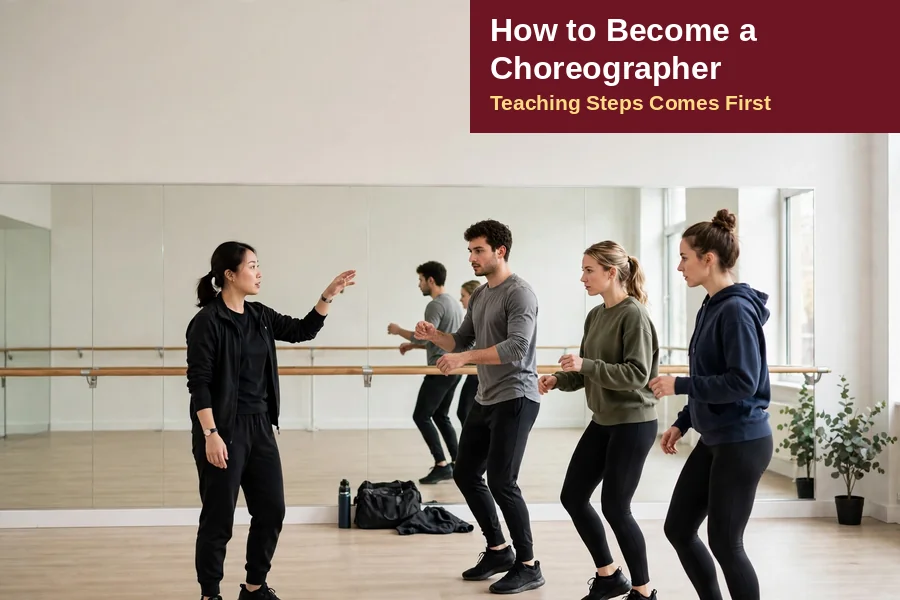
Assistant choreographer roles form the bridge between dancing and leading. You watch how a choreographer builds a routine, fixes weak sections and talks to a cast. You also learn rehearsal planning, which dancers rarely see from the floor. Small jobs with amateur clubs can start this learning early.
Dance captain work offers a related step, since captains lead dancers but do not invent steps. A mentor helps too, especially one whose work you admire. The UK Choreographers Directory through One Dance UK lists working choreographers to contact.
- Keep rehearsal notes and video records
- Teach steps when the choreographer steps away
- Run warm-ups and spacing checks
- Note casting ideas during auditions
Make Small Pieces: Your First Choreography Portfolio
A showreel of finished work proves more than any course list. Film short pieces for friends, school groups or community shows, then edit them cleanly. Short, sharp clips beat long, shaky recordings every time. Hirers judge timing, spacing and cast control from those clips alone.
Start with one short piece, not a full evening show. Choose music you know well, cast dancers you trust, and rehearse until spacing holds without prompts. Ask for blunt feedback after each showing, then rework weak sections before filming again.
Video records matter as much as live shows for a new choreographer. Dancers learn faster from clips they can replay between rehearsals. Keep one clean record of each piece, with counts marked for the cast.
- One short group routine
- One solo or duet with a clear story
- One rehearsal clip showing you teaching steps
Find Paid Work: Theatre, Television, Music Videos and Events
Paid choreography work spans theatre, musicals, opera, film, television and live music. Music videos, fashion shows and corporate events also hire choreographers for single numbers. Around 200 dance companies work in the UK, yet many choreographers still work freelance. Jobs cluster in London, with touring work across the regions.
Singers on stage and on video need routines that fit their songs. Our guide to how to become a singer covers auditions and stage craft for vocal performers. Work for singers shows how to become a choreographer in pop as well as theatre.
- West End and touring musicals
- Television talent and variety shows
- Pop tours and music videos
- Cruise, resort and corporate events
The Money: Freelance Fees, Quiet Gaps and No Fixed Salary
Most choreographers work freelance on fixed term contracts, not salaried posts. Fees are agreed per project and shift with track record, location and production budget. A well known name can charge more, while a newcomer accepts smaller fees to build credits. Teaching, performing and community work often fill gaps between projects.
No reliable current average salary exists for this role in official careers guidance. The National Careers Service profile for choreographers publishes no salary figure at all. Anyone quoting one fixed average for how to become a choreographer should show the source first. Equity, the performing arts union, can advise on rates for stage work.
- Price each project, not each week
- Keep tax and records from day one
- Hold a teaching income beside freelance projects
Your First Ten Dancers Are Your First Interview
Your first ten dancers are your first interview, so treat that small cast well. Teach clearly, rehearse fairly and film the result with care. Each finished piece opens the next door in theatre or pop. You learn how to become a choreographer by doing the work.
Our Celebrity archive gathers every career guide in this cluster. Browse it for dancer, singer and acting routes beside this guide. New guides in this cluster will link here as the set grows.
Frequently Asked Questions
Do I need a degree to become a choreographer?
No degree is compulsory, but dance training at a high level is expected. A degree in dance or musical theatre can build technique and contacts. Many choreographers still reach the role through stage work and assistant roles alone.
How long does it take to become a choreographer?
There is no set timetable, since dancers reach the role at different speeds. Most spend years performing first, then assist choreographers before leading their own pieces. Small community pieces can start much earlier, while large stage commissions take longer to earn.
Do choreographers need to be good dancers first?
Yes, in practice, since you must show steps clearly to a cast. Dancers trust a leader who can demonstrate timing, weight and spacing from experience. Strong dance training also helps you judge what a cast can safely perform.
What should go in a choreography showreel?
Include short, finished routines that show timing, spacing and cast control. Add one group routine, one smaller piece and one clip of you teaching steps. Keep clips sharp, short and easy to watch on a phone screen.
Is choreography work mostly freelance?
Yes, most choreographers work freelance on fixed term contracts. Full time posts exist with dance companies and community arts ventures, but they are fewer. Teaching and performing often steady income between choreography projects.
Where do new choreographers find their first jobs?
Amateur clubs, school groups and community shows offer early chances to lead a room. Assist established choreographers, join One Dance UK and watch listings in The Stage. Each small credit builds the contacts that lead to paid stage work.