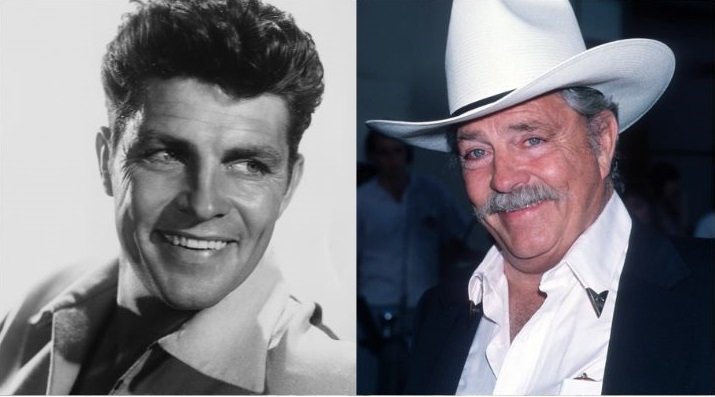
Dale Robertson is one of the most recognizable names in American Western entertainment, and yet the story of how he got there reads more like a lucky accident than a carefully laid plan. A small-town Oklahoma boy who spent his early years farming, playing sports, and later dodging enemy fire in World War II, Dale Robertson didn’t audition for fame. Fame spotted him through a photographer’s shop window. From that single photograph, a career spanning nearly five decades was born — one that would make him a household name across America and cement his place as a true icon of the Western genre.
Today, many fans wonder why Dale Robertson doesn’t get the same level of recognition as some of his Hollywood contemporaries. Maybe it’s because he wasn’t flashy. He didn’t chase the spotlight or court controversy. He was simply a man who showed up, did the work, and let his quiet, rugged presence do all the talking. That’s exactly what made audiences fall for him — and why his legacy still holds up decades later. If you’ve ever wanted to know the full story behind the man who made Jim Hardie one of television’s most beloved characters, you’re in the right place.
Dale Robertson’s Early Life
Dale Robertson was born on July 14, 1923, in Harrah, Oklahoma, a small town tucked away in the heartland of America. His full name was Dayle Lymoine Robertson, and he came into the world as the son of Melvin and Vervel Robertson. Growing up in a rural Oklahoma community during the Great Depression wasn’t easy — it built a kind of toughness in a person that no acting class could ever teach. And for Dale, that toughness became his greatest on-screen asset.
He wasn’t sitting around dreaming of Hollywood back then. Instead, he was excelling on the athletic field at Classen High School in Oklahoma City, where he made a name for himself as a natural competitor. His physical ability and work ethic led him to the Oklahoma Military Academy in Claremore, where he continued to grow both mentally and physically. There was nothing particularly Hollywood about any of this — just a determined young man carving out his path the hard way, one step at a time.
When World War II broke out, Dale Robertson answered the call without hesitation. He joined the U.S. Army and was assigned to serve with the 777th Tank Battalion in North Africa, where conditions were brutal and every day brought genuine danger. Later, he was transferred to the 322nd Combat Engineer Battalion in Europe, fighting across terrain that asked everything of the men who crossed it. He wasn’t just playing a tough guy on screen — he was the real deal long before cameras ever pointed his way. He was wounded twice during his service and came home with the Bronze Star, Silver Star, and Purple Heart to show for it. These weren’t props. They were hard-earned proof of who Dale Robertson really was.
How Dale Robertson Stumbled Into Acting?
Here’s where the story takes a turn that even the best screenwriter couldn’t have cooked up. While Dale Robertson was stationed in San Luis Obispo, California, he had a photograph taken — nothing dramatic about it, just a photo for his mother back home. The photographer, apparently recognizing something in the young soldier’s face and frame, displayed the picture in the shop window. That single decision changed everything.
Hollywood scouts noticed the photo. Letters from film agents started finding their way to Dale while he was still serving in the South Pacific. He came back from the war to find that the entertainment industry was already knocking on his door. He hadn’t knocked on theirs. That kind of irony has a way of sticking with you — the man who survived tank warfare in North Africa was about to conquer Hollywood without even trying.
Around this time, Dale got some advice that would stay with him for the rest of his career. Actor Will Rogers Jr. pulled him aside and said something simple but powerful: “Don’t ever take dramatic lessons.” Rogers believed that Dale had something raw and natural in him — an authenticity that formal training would only sand away. Dale took that advice to heart. He never signed up for acting classes, and looking back, that decision was probably the smartest career move he ever made. His unpolished, straight-shooting style was exactly what audiences were hungry for, and no acting coach would have given him that.
His first real breakthrough came with The Boy with Green Hair in 1948. It wasn’t a Western, but it put him on the radar. Then in 1949, he played Jesse James in Fighting Man of the Plains, and just like that, the Western machine had a new leading man. Other early roles followed, including Call Me Mister and The Farmer Takes a Wife, each one building his reputation as a reliable, watchable screen presence. The cowboy hat fit him like it was made to order.
Dale Robertson’s Career
Over the course of his career, Dale Robertson appeared in 63 films and a long string of television shows, making him one of the most prolific Western performers of his era. In 1959, Time magazine called him “possibly the best rider on television,” which wasn’t just a compliment — it was a statement about how convincingly he inhabited the Western world. Below is a look at some of his most significant film work during the peak of his movie career:
| Year | Film |
|---|---|
| 1952 | Return of the Texan |
| 1953 | Devil’s Canyon |
| 1953 | City of Bad Men |
| 1954 | Sitting Bull |
| 1956 | Dakota Incident |
| 1957 | Hell Canyon Outlaws |
Each of these films added another coat of polish to the Dale Robertson Western persona — the slow-talking, straight-riding, fair-fighting hero who never needed to raise his voice to command a room. He wasn’t a one-note actor, but Westerns were where he shone brightest, and audiences made it very clear they agreed.
Tales of Wells Fargo
If there’s one role that defines Dale Robertson’s career, it’s Jim Hardie in Tales of Wells Fargo, which ran from 1957 to 1962. The show followed Hardie, a special agent for the Wells Fargo stagecoach company, as he tracked outlaws and kept the frontier safe. It sounds simple enough on paper, but on screen, Dale Robertson made Hardie feel like a man you’d genuinely want watching your back. His slow south-western drawl, calm-under-pressure demeanor, and natural authority made Hardie one of the most believable Western heroes in television history.
The show was a massive hit. Week after week, American families sat down and watched Dale Robertson ride across the screen with that unhurried confidence that had become his trademark. Jim Hardie wasn’t just a character — he was a symbol of fairness, courage, and resilience. In an era when America was hungry for straightforward moral heroes, Dale Robertson delivered exactly that, and he did it without a single acting lesson to his name.
| TV Series | Years | Role |
|---|---|---|
| Tales of Wells Fargo | 1957–1962 | Jim Hardie |
| Iron Horse | 1966–1967 | Ben Calhoun |
| Death Valley Days | 1968–1970 | Host |
| Dynasty | 1981 | Original cast member |
| J.J. Starbuck | 1987–1988 | J.J. Starbuck |
| Harts of the West | 1993–1994 | Supporting role |
After Wells Fargo, Dale starred as Ben Calhoun in Iron Horse from 1966 to 1967, another Western series that gave him the chance to keep doing what he did best. He then stepped into the role of host for Death Valley Days from 1968 to 1970, a gig that suited his natural presence and easy storytelling manner perfectly.
Dale Robertson’s Later Career and His Range Beyond Westerns
Not everything Dale Robertson did involved a horse and a six-shooter. In the 1970s, he stretched his range and took on some gangster roles that showed audiences a different side of the man they thought they knew. He appeared in Melvin Purvis: G-Man and The Kansas City Massacre, both of which gave him the chance to play characters with a harder edge and a more complicated moral compass. He handled these roles with the same steady professionalism that had defined his Western work, proving that his talent wasn’t limited to one genre.
In 1981, he joined the original cast of Dynasty, the iconic prime-time soap opera that was burning up the ratings at the time. It was a very different world from the dusty trails of Wells Fargo, but Dale fit in without missing a beat. Then in 1987, he headlined J.J. Starbuck, a detective series where he played a billionaire Texas businessman who goes around the country solving crimes. The role had the same charm and wit that fans loved about him, just in a different setting. His final television appearance came with Harts of the West from 1993 to 1994, wrapping up an active career that had lasted from 1948 all the way to 1994 — a remarkable run of 46 years in the entertainment business.
Awards and Recognition
Dale Robertson earned a star on the Hollywood Walk of Fame for his television contributions, a recognition that placed him alongside the biggest names in the industry. He also received Golden Globe Award nominations over the course of his career, acknowledging the quality and consistency of his work across both film and television. Add to that his military honors — the Bronze Star, Silver Star, and Purple Heart — and you’ve got a man whose achievements stretched far beyond the screen.
His legacy is the story of an authentic American hero, both on camera and off. Dale Robertson didn’t play a rugged, honest Westerner — he essentially was one, and audiences sensed that truth every time he appeared on screen. There’s a reason his work still draws fans today. In a television world full of calculated performances and manufactured personalities, Dale Robertson’s naturalness stands out like a lighthouse in the fog. He was the real thing, and that kind of realness never goes out of style.
| Achievement | Detail |
|---|---|
| Hollywood Walk of Fame Star | Television contributions |
| Golden Globe Nominations | Multiple nominations during career |
| Military Honors | Bronze Star, Silver Star, Purple Heart |
| Career Films | 63 films |
| Career Span | 1948–1994 (46 years) |
| Notable TV Role | Jim Hardie, Tales of Wells Fargo (1957–1962) |
Dale Robertson’s Marriages, Family, and Net Worth
Dale Robertson was married four times over the course of his life. His first three marriages were to Frederica Jacqueline Wilson, Mary Murphy, and Lula Mae Robertson. Each of these relationships produced chapters in a personal life that was as eventful as his professional one. From these earlier marriages, Dale had three biological daughters.
His fourth and final marriage, to Susan Dee Robbins in 1980, was the one that lasted. Susan was a former flight attendant, and together they built a life that held steady for 32 years, right up until Dale’s death in 2013. Susan was stepmother to his three daughters and the two shared a bond that clearly stood the test of time. It’s one of those love stories that doesn’t need embellishments — the numbers speak for themselves.
Off-screen, Dale Robertson was a rancher at heart. He owned property in Oklahoma, where he’d return to the land that had shaped him as a boy. That connection to the earth, to horses, to wide-open spaces — it wasn’t a performance. It was just who he was. At the time of his death, his net worth was estimated at $5 million, built through decades of acting work combined with his Oklahoma ranch ownership. He left his estate to his wife and children, a fitting final act from a man who valued family above all else.
| Personal Detail | Information |
|---|---|
| Number of Marriages | 4 |
| Final Spouse | Susan Dee Robbins (1980–2013) |
| Marriage Duration (final) | 32 years |
| Children | 3 biological daughters |
| Net Worth at Death | $5 million |
| Property | Oklahoma ranch |
The Death of Dale Robertson
Dale Robertson passed away on February 27, 2013, at the age of 89. He died at Scripps Memorial Hospital in La Jolla, California, after a battle with lung cancer and pneumonia. He was survived by his wife Susan and two of his children. His passing marked the end of an era — the quiet closing of a chapter in American entertainment history that had been open since the late 1940s.
News of his death was met with an outpouring of tributes from fans and fellow actors who remembered him not just as a talented performer, but as a genuinely good man. He had lived a full life — from the red dirt fields of Harrah, Oklahoma, to the battlefields of North Africa and Europe, to the Hollywood backlots and the television screens of millions of American homes. Not many people can say they lived that kind of a story. Dale Robertson could, and he lived every chapter of it honestly.
Last Words
The story of Dale Robertson is the kind of story that American culture was built on — unexpected opportunity, hard work, natural talent, and the quiet dignity of a man who never forgot where he came from. He didn’t plan to be an actor. A photograph in a shop window set everything in motion, and from that moment, he rode the wave with the same cool confidence he brought to every role he ever played.
Dale Robertson was, in the truest sense, a true American original. He came from nothing, built something remarkable, and left behind a body of work that continues to hold up decades after his final curtain call. The Western genre has given America many heroes over the years, but few of them came with Dale Robertson’s combination of battlefield courage, natural screen presence, and genuine humility. That’s a legacy worth remembering — and worth celebrating every time someone sits down and presses play on an old episode of Tales of Wells Fargo.