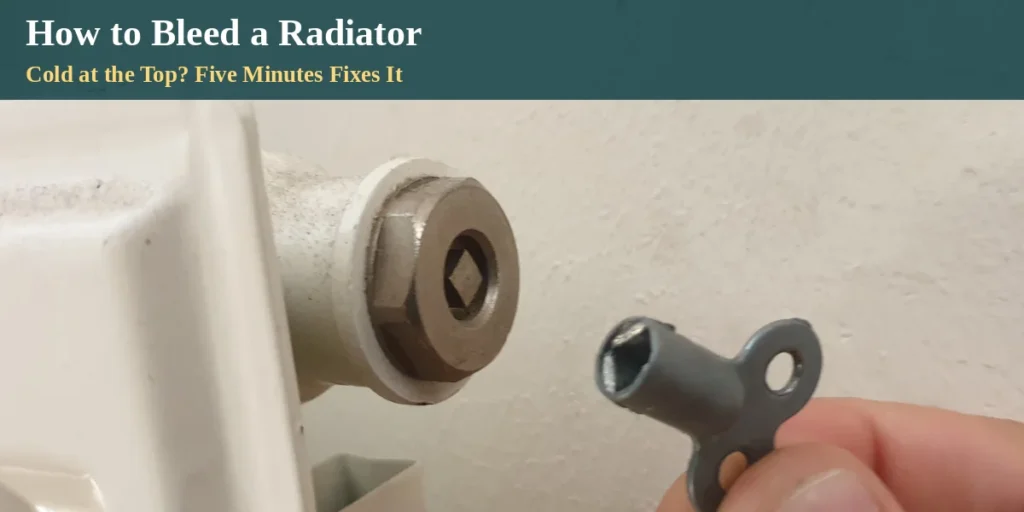
To bleed a radiator, turn the heating off and let it cool fully. Hold a cloth under the bleed valve at the top corner. Open it a quarter turn anticlockwise with a radiator key. Close it when the hissing stops and water trickles out steadily.
That pocket of trapped air is why the top stays cold. Hot water cannot rise past it, so the room never warms properly. This guide explains how to bleed a radiator, start to finish. It covers the order, the pressure check and the warning signs.
It sits on the list of small jobs that keep heating bills down. Our budget home improvement guide collects more of them in one place. Do this one first, before the cold weather settles in.
Key Takeaways
- Knowing how to bleed a radiator fixes cold tops fast.
- Cold at the top and warm below means trapped air.
- You need a radiator key, a cloth and a small cup.
- Turn the heating off and let radiators cool first.
- Open the valve a quarter turn, never fully.
- Work downstairs first, then move upstairs.
- Check the boiler pressure gauge when you finish.
- Cold at the bottom points to sludge, not air.
How to Tell Which Radiators Need Bleeding
Run the heating for twenty minutes, then feel each radiator carefully. A radiator that needs bleeding feels warm low down and cool across the top. Gurgling or bubbling noises point to the same trapped air.
Air rises inside a radiator, so it gathers at the top. Sludge sinks, so it settles along the bottom edge instead. That one difference tells you which fix the radiator needs. Use the table below before you reach for the key.
| What you feel | Likely cause | The right fix |
|---|---|---|
| Cold at the top, warm below | Trapped air | Bleed the radiator |
| Cold at the bottom, warm above | Sludge build-up | Engineer flush, not bleeding |
| Cold all over, pipes warm | Closed or stuck valve | Check the valves, then call help |
| Every radiator lukewarm | Low boiler pressure | Top up the pressure first |
Note the cold ones on your phone or a scrap of paper. You will bleed only those radiators today, not the whole house. Bleeding healthy radiators just drops your boiler pressure for nothing.
What You Need Before You Start
The full kit for how to bleed a radiator costs about £1. A radiator bleed key costs roughly £1 in any DIY shop. British Gas gives the same figure in its winter heating tips.
- Radiator bleed key, or a flat-head screwdriver on newer valves
- An old cloth or towel to catch the drips
- A small cup or jug held under the valve
- A phone torch for dark corners behind furniture
One safety point matters more than the tools themselves. Never bleed a radiator while the system is hot. The water inside can scald skin in seconds. Switch the heating off and wait until every radiator feels cool.
Bleeding never touches the boiler casing or the gas supply. It is one of the few heating jobs any homeowner can do. Anything inside the boiler belongs to a Gas Safe registered engineer.
How to Bleed a Radiator, Step by Step
Work through the same routine at each radiator that needs it. Work slowly and keep the cloth under the valve throughout. The whole job takes about five minutes per radiator.
- Turn the heating off and let the radiator cool fully.
- Find the bleed valve at the top corner of one end.
- Hold the cloth and cup under the valve to catch drips.
- Fit the key and turn it anticlockwise, a quarter turn only.
- Listen for the hiss of air escaping from the valve.
- Wait until the hiss stops and water trickles out steadily.
- Turn the key clockwise to close the valve firmly.
- Wipe the valve and check it stays dry afterwards.
Never unscrew the bleed valve all the way out. Pressure can pop it free and flood the floor fast. A quarter to half a turn is always enough. If the key will not turn, stop and leave it alone.
A stiff or rounded valve can snap under real force. Forcing it turns a free job into a plumber’s bill. Note that radiator and move to the next one.
The Right Order for a Whole House
Bleed downstairs radiators first and the upstairs ones last. Within each floor, start with the radiator furthest from the boiler. Work back towards the boiler, one radiator at a time.
Air collects highest in the system, so upstairs radiators hiss longest. Doing the ground floor first pushes air upwards ahead of you. You then release it once, at the top of the house.
Heated towel rails bleed the same way as panel radiators. Their bleed valve sits at the top of one upright rail. On a dual fuel rail, switch the electric element off first.
Check the Boiler Pressure Afterwards
Bleeding lets water out, so the pressure in a sealed system falls. Find the round pressure gauge on the front of your boiler. A cold system should read between 1 and 1.5 bar.
Top it up if bleeding has dropped it below 1 bar. Open the filling loop valves slowly and watch the gauge climb. Close both valves again at roughly 1.2 to 1.5 bar.
The filling loop is the small braided hose beneath most combi boilers. Your boiler manual shows its exact position for your model. Homes with a loft header tank refill differently, so check first.
What the Water Tells You
Catch the first drips in your cup and look at them. Clear water is the sign of a healthy, clean system. Grey or black water tells a different story about corrosion.
Dark water carries iron oxide sludge from inside the radiators. A little in one old radiator is common and harmless today. It still deserves noting for your next boiler service.
Black water from several radiators means the system is dirty throughout. An engineer can flush it and add corrosion inhibitor afterwards. A magnetic filter then traps debris before it settles again.
When Bleeding Is Not the Fix
Some cold radiators have nothing to do with trapped air. Bleeding those ones achieves nothing and wastes your afternoon. Check the fault against the signs below before repeating the job.
- Cold at the bottom: sludge is blocking the flow, so book a flush.
- Cold all over: check the thermostatic valve is turned up fully.
- Still cold with warm pipes: the valve pin may be stuck shut.
- Pressure keeps falling weekly: water is leaking somewhere in the system.
- Cold again within days: air is getting back in somewhere.
A radiator cold again within days needs proper investigation. Air entering the system can point to a fault or slow leak. Keep topping up and bleeding, and the problem quietly grows.
Smell gas at any point and the job stops immediately. Leave the property and call the National Gas Emergency line, 0800 111 999. Do not touch the boiler, and do not hunt for the leak.
The Whole House, Warm by Bedtime
You now know how to bleed a radiator the right way. Bleed once each autumn, when the heating first goes on. After that, only bleed a radiator showing real cold spots. The rest of the year your system should look after itself.
Keep the bleed key somewhere you will actually find it. The boiler cupboard or the meter box both work well. A key you cannot find leaves cold radiators until spring.
More cold weather jobs wait in our Home Improvement guides. Our squeaky floorboards guide fixes the other noise most homes make. Warm rooms and quiet floors make winter far easier.
Frequently Asked Questions
Do you bleed a radiator with the heating on or off?
Always with the heating off and the radiators fully cool. Hot water inside a radiator can scald you as it escapes. Cooling also lets trapped air settle at the top, right beside the bleed valve. Wait about thirty minutes after switching off.
Which radiator do you bleed first in a house?
Start on the ground floor with the radiator furthest from the boiler. Work back towards the boiler, then repeat the same order upstairs. Air rises through the system, so upstairs radiators usually hold the most. This order stops you chasing the same air twice.
Why is my radiator cold at the bottom?
A cold bottom usually means sludge, not trapped air. Sludge is heavy corrosion debris that settles along the base of the radiator. Bleeding cannot shift it at all. A heating engineer clears it with a power flush or chemical flush instead.
How often should you bleed your radiators?
Once a year suits most homes, ideally in autumn before winter. That single check catches air that built up over summer. Beyond that, bleed only when a radiator turns cold at the top. Bleeding healthy radiators just lowers your boiler pressure.
What does black water from a radiator mean?
Black water means corrosion is happening inside your heating system. The colour comes from iron oxide sludge carried in the water. One radiator with dark water is common in older homes. Several radiators like it suggest the system needs an engineer’s flush.